Equilibrium, Disturbance and Natural Frequency
An object at rest can settle where the forces acting on it balance out. This is its equilibrium position. Anything that pushes it away from that position, such as a tap, a pluck, wind or a sound wave, is a disturbance. In an elastic object, displacement produces a restoring force that pulls it back. Repeated movement back and forth is vibration; the number of cycles per second is its frequency.
Take a drinking glass. Tap it with a fingertip and it seems to stay perfectly still. But as it goes "ting," the rim is deforming by a tiny amount, far too quickly for your eyes to follow. That creates the illusion of sound from something motionless. The glass walls are pushing the air hundreds of times a second, and that motion is what we hear.
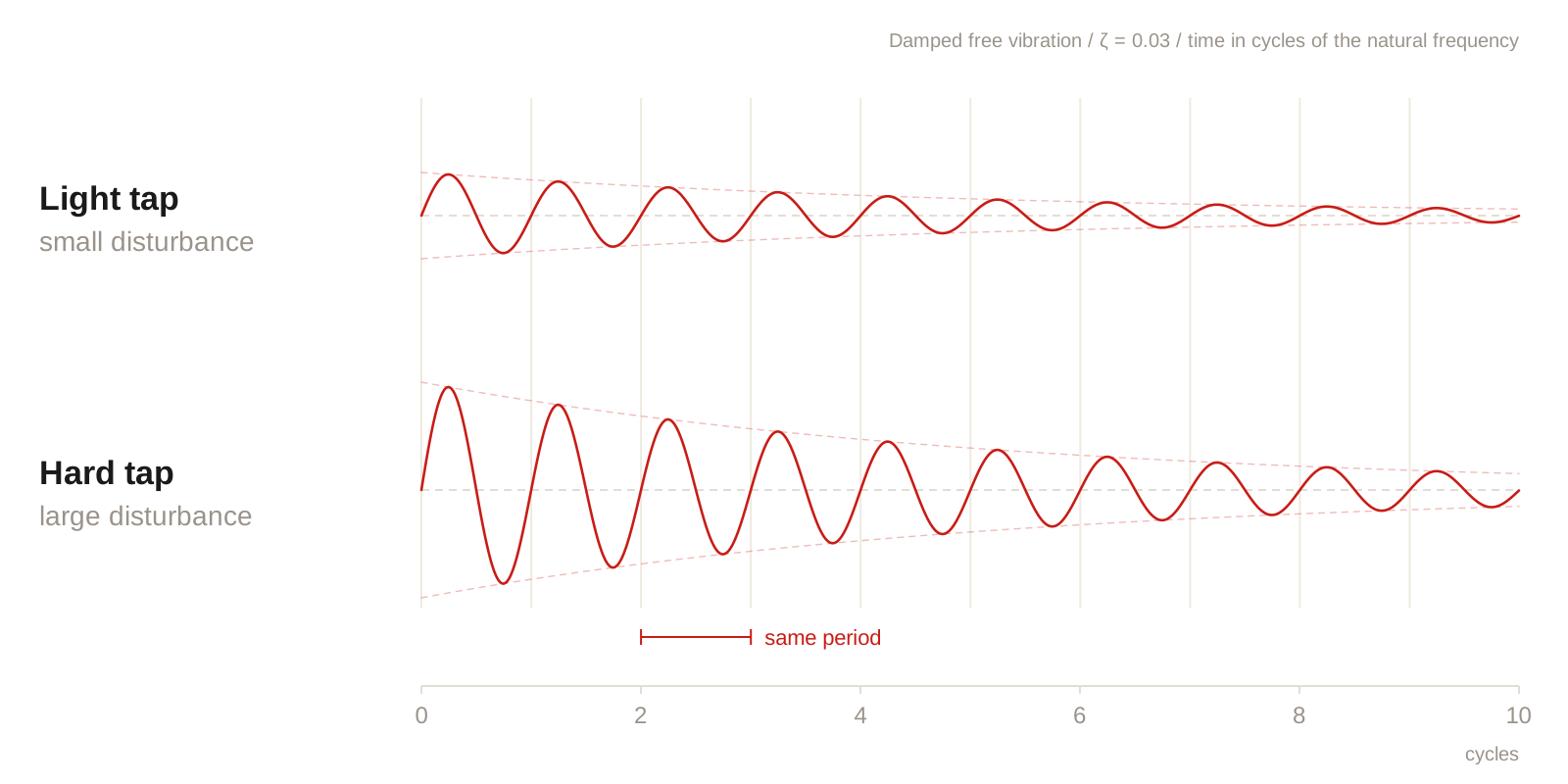
More interestingly, tapping the same glass harder usually makes it louder without noticeably changing its pitch. That is because an object has its own natural frequencies. After a disturbance, it tends to vibrate at those frequencies; in the range where its response is approximately linear, the strength of the disturbance mainly changes the amplitude, or how loud it sounds. For a simple resonator, two properties are central:
- Mass: More mass is harder to accelerate, making the motion slower if stiffness stays the same.
- Stiffness: A stronger restoring force pulls it back faster, making the motion quicker if mass stays the same.
Musical instruments make use of this. A guitar string's length, thickness and tension determine its pitch; pressing a fret shortens the vibrating length. Hold a ruler against the edge of a table and pluck it: a longer overhang wobbles more slowly. Blow across a bottle opening: adding water reduces the air volume and raises the pitch. The changing sound as you fill a container is another familiar clue that its resonances are changing. Steel, wood, bridges and buildings also have elasticity and natural frequencies, even when their motion is too small or too slow to hear. After a disturbance, an object can vibrate at its natural frequencies, gradually settling as energy is lost.
An object usually has more than one natural frequency. A glass rim can deform into an oval or into more complex shapes, and each vibration mode has its own frequency. The lowest prominent mode often dominates the pitch, while the others mix into the sound and give each glass its character. This resembles a harmonic series, except that the mode frequencies of a glass generally are not integer multiples of one fundamental. Their inharmonicity is much more pronounced than that of a typical musical string.
How to Break a Wine Glass, Elegantly
A famous Memorex advertising campaign from the 1970s featured Ella Fitzgerald singing a high note that shattered a wine glass, followed by a recording doing the same. The line was: "Is it live, or is it Memorex?" The ad's point was that the recording sounded indistinguishable from the real thing. Physically, though, breaking a glass is not a general test of recording fidelity.
Whether the source is a live voice or a recording, the essential conditions are the same: drive the glass near one of its natural frequencies, with enough acoustic energy and sufficiently low losses. The rim's motion can then build until the deformation exceeds what the glass can withstand. Matching the pitch alone is not enough; the driving level also matters.
Forced Vibration and Resonance
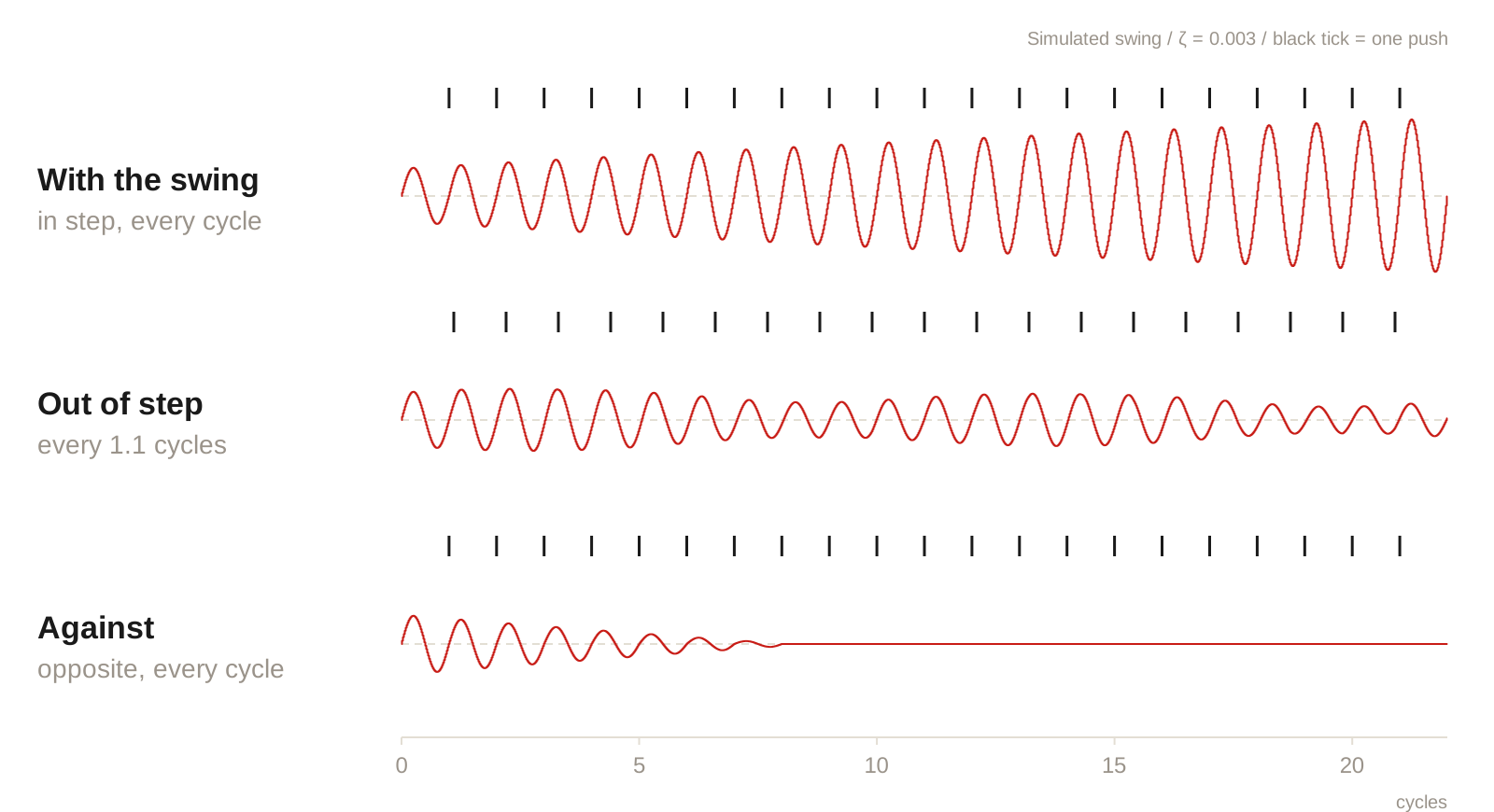
A glass moves too little and too quickly to watch easily, so imagine a playground swing instead. Once it is moving, the timing of your pushes gives three useful cases:
- Always push with the motion: Each push adds energy. Even gentle pushes can build a larger swing over successive cycles.
- Sometimes with it, sometimes against it: If your rhythm differs from the swing's, the timing drifts. Energy goes in and then comes back out, so the swing grows and shrinks instead of steadily getting higher.
- Always push against the motion: Each push removes energy, making the swing smaller until it stops.
When an external force keeps driving an object like this, we call it forced vibration.
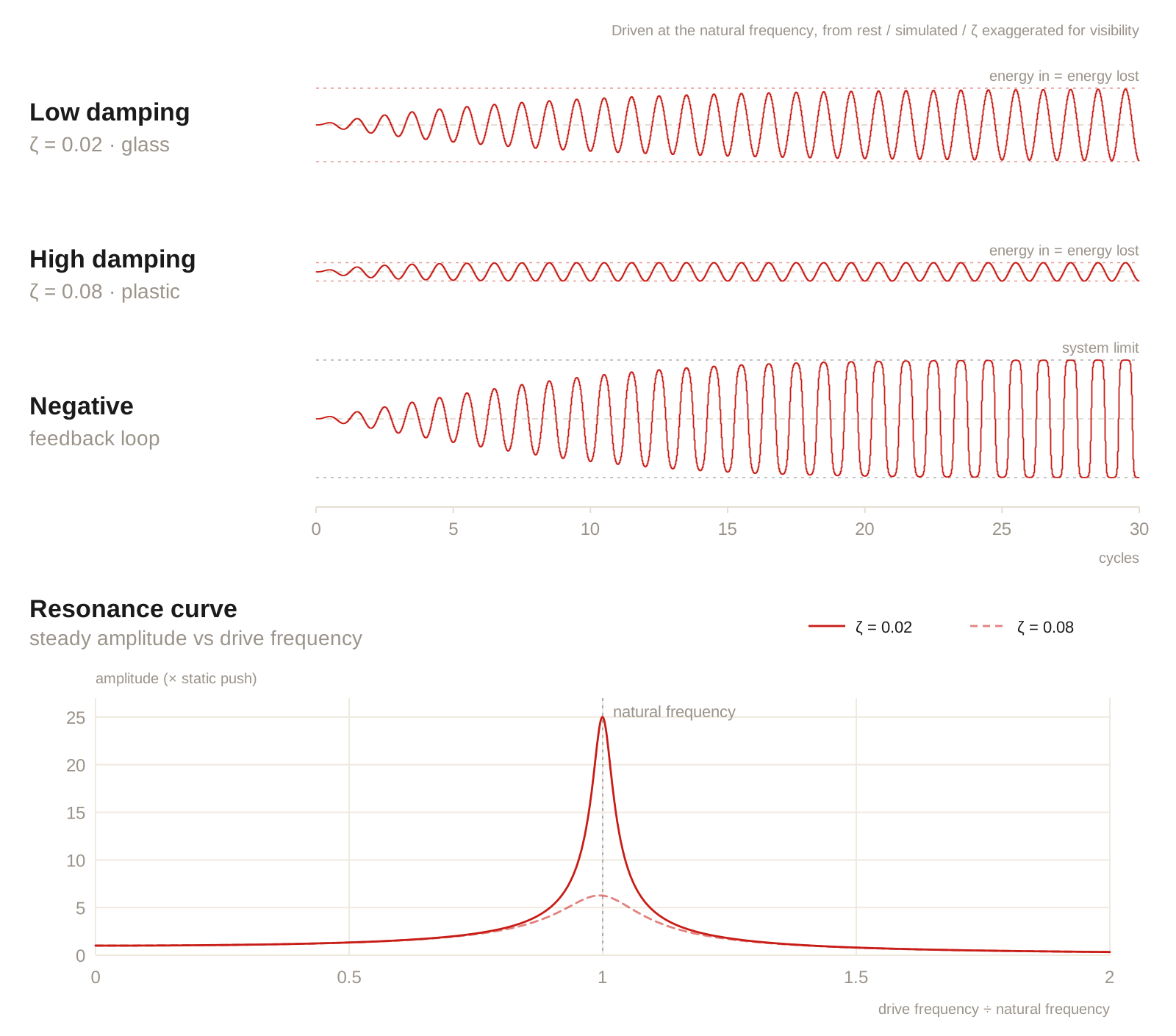
At the start of forced vibration, the object can carry two rhythms at once: its own free vibration after the initial disturbance, and the frequency of the driving force. They combine, sometimes reinforcing and sometimes canceling, making the amplitude rise and fall. With damping, the free vibration gradually dies away, just as it would after a single push. What remains follows the frequency of the external force.
At that point, the natural frequency helps determine how strongly the object responds, rather than setting the rhythm it follows. For a lightly damped resonator, driving near its natural frequency builds a much larger response than driving far away from it. That pronounced response is resonance. It is not simply the result of using the strongest or loudest force. The relationship between the driving frequency and the object's own dynamics matters.
Damping
Strike a bell and it can ring for seconds. Tap a table and the knock is gone almost immediately. Both have natural frequencies. One difference is how much energy friction, air resistance and losses inside the material remove on each cycle. Those losses are called damping. When we said energy needed to escape slowly, we meant damping needed to be low.
In steady forced vibration, the driver supplies energy and damping removes it. The amplitude settles when the two balance. A strongly damped object reaches that balance at a small amplitude. A lightly damped resonator can build a much larger motion before its losses match the incoming energy. That helps explain why a suitable crystal glass can be broken by a sufficiently strong, well-matched tone, while a plastic cup is much less likely to respond that way. Material losses and the structure itself make a difference.
Breaking a glass therefore calls for resonance, low enough damping and sufficient drive. Energy must accumulate until the rim deforms beyond the glass's breaking point. If losses balance the incoming energy before that happens, the glass keeps vibrating without breaking.
Resonance in Everyday Life
A car may shake especially strongly at a particular speed. A washing machine can wobble most dramatically during one part of its spin-up. In both cases, a driving frequency may be sweeping through a natural frequency and briefly exciting resonance. Once understood, resonance became something people could put to work, and inventions in one field often found uses in another.
In 1711, the English court trumpeter John Shore invented the tuning fork. Compared with the pitch pipes used at the time, it provided a stable, clear reference tone for tuning instruments.
Its geometry and material largely determine its natural frequency, so ordinary changes in striking force do not appreciably change its pitch. During the nineteenth century, it also became a precision scientific instrument. The Whipple Museum describes this history.
Today, many quartz watches still contain a tiny tuning fork: a piece of quartz shaped and tuned to vibrate 32768 times per second. The circuit counts those cycles to keep time.
In 1909, German engineer Hermann Frahm applied for a patent on a vibration absorber developed in connection with ship vibrations. A small mass and spring attached to a main structure can be tuned to respond near the troublesome frequency, counteracting the structure's motion. With damping, the transferred energy can be dissipated. The same family of ideas leads to the tuned mass damper, familiar today as the enormous suspended ball near the top of Taipei 101.
In 1967, electronic engineers Kerwin, Huelsman and Newcomb addressed a different problem: making active filters less sensitive to component variations in integrated-circuit applications. Their approach used state-variable methods associated with analog computation. Two integrators in a feedback loop could model the behavior of a mass, spring and damper, with frequency and damping controlled independently. This state variable filter, or SVF, began as an engineering solution. It soon found its way into synthesizers and became one of the familiar filter structures in synthesizers and effects.
Resonance in Sound
Instrument Resonance
A string is thin and does not move much air by itself, so its direct acoustic sound is quiet. The bodies of guitars and violins are designed to respond to the strings. Vibration passes into the body and the air inside it, moving more air and making the instrument audible. Different shapes, materials and construction produce different resonances, emphasizing different frequency regions and giving each instrument its character.
Play an instrument one fret at a time and listen closely to the level and sustain of each note. They are rarely identical. An instrument whose notes respond evenly is often described as well balanced. One with especially full low notes might have a thick low end. If certain notes fade unusually quickly, players call them dead spots.
The body and neck contribute to these differences. Each has natural frequencies set by its materials, shape and construction. When a note lines up with a structural resonance, the result depends on how the vibration is coupled and where the energy goes. A body resonance can increase radiated sound in that region, making a low note sound fuller. A neck resonance can draw energy out of the string, reducing its sustain and producing a dead spot.
Some of these characteristics can be adjusted. If the bass strings sound too strong through the pickups, lowering the pickup on that side can help balance their output. A metal headstock clamp such as a Fat Finger adds mass and changes the neck's resonances, which can move a dead spot to a different note rather than simply eliminating it.
Resonance in the Mouth
Vocal-fold vibration sets the fundamental pitch of voiced speech, but the source by itself sounds like a buzz, with a fundamental and a row of harmonics. That sound travels through the vocal tract, including the throat and mouth, and sometimes couples into the nasal cavity. These spaces have their own resonances. They emphasize certain regions of the spectrum, producing peaks called formants.
Open or close your mouth, or move your tongue forward or backward, and the shape changes. The formants move with it, changing the vowel we hear. Try whispering: even without regular vocal-fold vibration or a clear fundamental pitch, you can distinguish an "ee" from an "ah." The vocal tract still shapes the sound into different vowels.
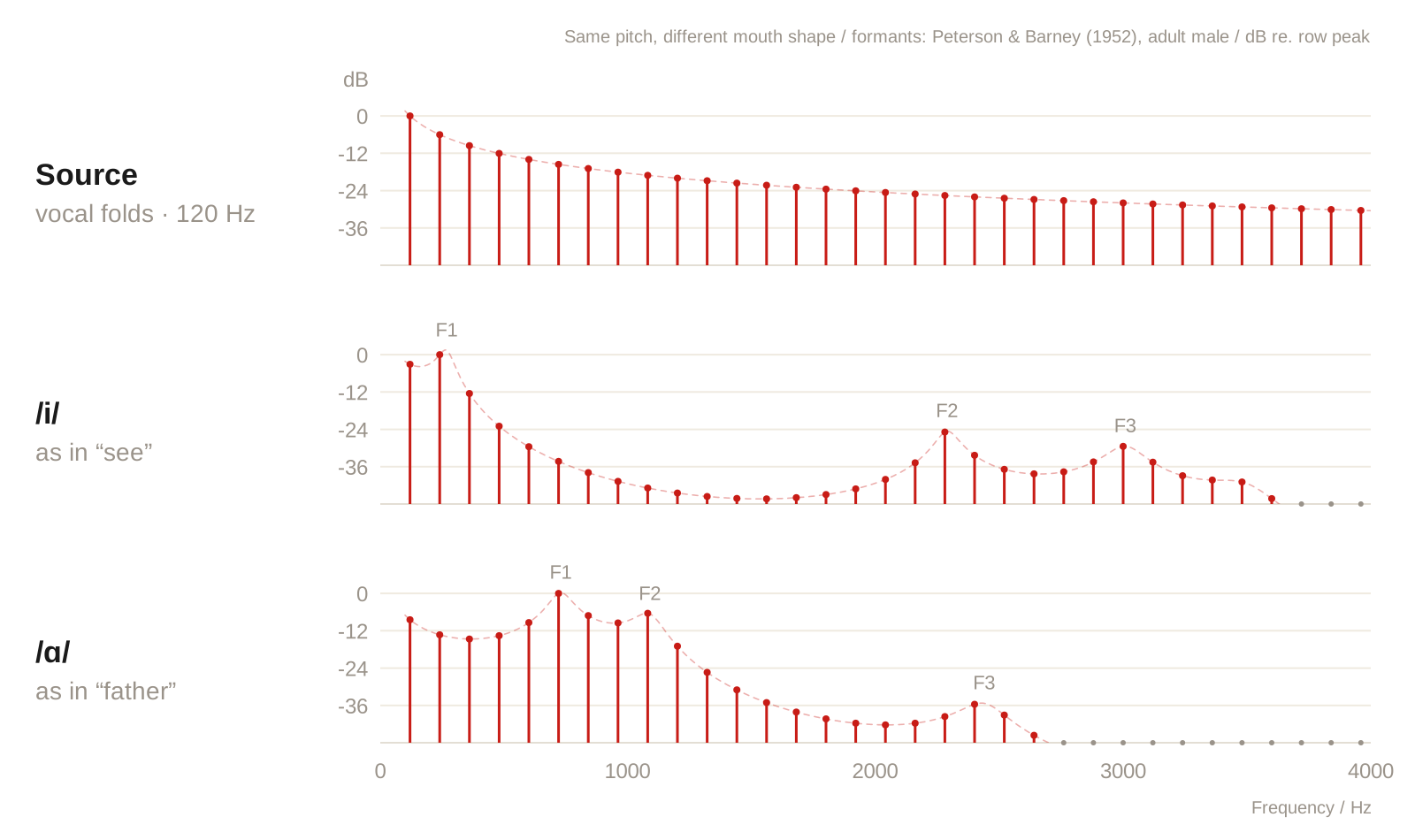
Vocal-tract habits vary between speakers and languages. Linguists use articulatory setting to describe habitual postures of the tongue, lips and jaw during speech. Languages can favor different tongue and lip positions, and their vowel systems occupy different regions of formant space.
These habits are one contributor to a foreign accent. When learning a language, we naturally relate unfamiliar sounds to the closest categories in our first language. Familiar articulatory habits can also carry over, shifting the formants toward familiar positions. Japanese, for example, does not have the same /r/–/l/ contrast as English. Its usual tap is a different sound, so learning the two English categories involves more than reproducing a sound halfway between them.
Pitch and vocal-tract shape are not entirely independent, either. Mandarin speakers demonstrate their separation every day: in mā, má, mǎ and mà, the basic vowel stays the same while the pitch contour changes. Tone helps distinguish the meanings. But vowel production can also influence pitch. Across many languages, high vowels such as /i/ and /u/ tend to have a slightly higher fundamental frequency than low vowels such as /ɑ/, other things being equal. This tendency is called intrinsic vowel pitch.
Resonance in the Ear
Inside the cochlea is a long basilar membrane whose width and stiffness vary along its length. The narrow, stiff region near the base responds most strongly to high frequencies. Farther toward the apex, it becomes wider and more compliant, responding to lower frequencies.
As a useful approximation, think of it as a bank of overlapping frequency detectors, each most sensitive to a particular region. The pattern of motion, converted into neural signals by sensory hair cells, gives the brain information about the frequencies in a sound. One common hearing model describes the audible range using roughly 24 critical bands. This is part of how harmonics are separated before the brain uses their spacing to infer pitch.
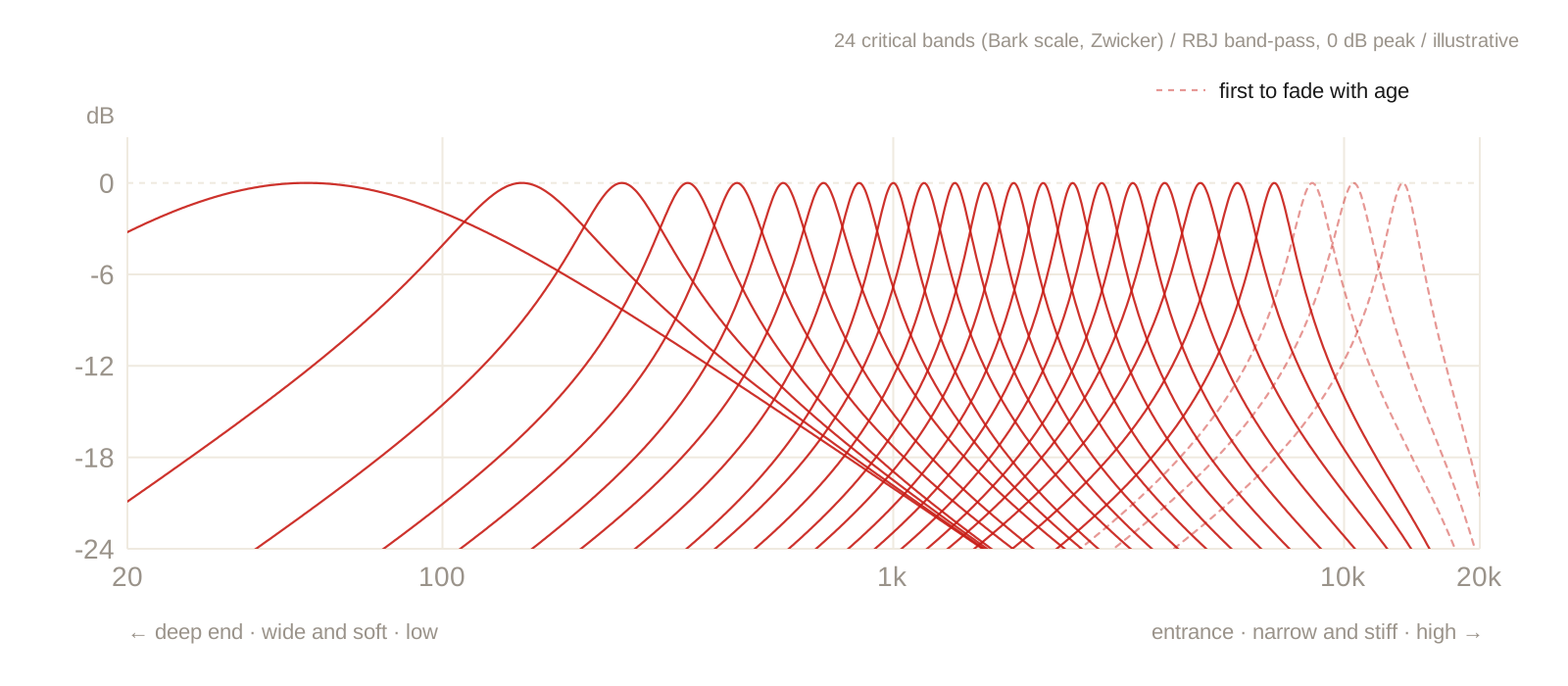
Hearing sensitivity can decline with age, often affecting high frequencies first. The changes involve sensory cells and other parts of the hearing system, rather than the membrane simply wearing out. Aging, long-term noise exposure, genetics and some health conditions can all contribute; the details vary between people. NIDCD explains these contributing factors. One familiar example is a very high ringtone that some younger listeners can hear clearly while older listeners cannot.
Feedback Resonance
Point a microphone toward a speaker and sound can travel from the speaker into the microphone, through the amplifier and back to the speaker. This loop is feedback. If the loop has enough gain and the right phase relationship at a frequency, the sound grows on each trip. It is like negative damping: instead of losing energy each cycle, the motion gets an extra push. Its amplitude grows until something limits it.
The pitch of the resulting squeal depends on the whole loop. The room, speaker and microphone all shape its frequency and phase response, and resonances can give certain frequencies an advantage. After enough trips around the loop, one of them may dominate the others, producing that piercing howl until the system reaches its limits.